Keddah
The Jungle BookKeddah is the stockade used by the Government of India’s elephant-catching department, a massive enclosure in the forest where captured elephants are confined and wild herds are broken into manageable groups. It is both a practical instrument of colonial labor and a charged threshold in the story of Little Toomai: the place where trained elephants confront wild ones, where skill is measured under danger, and where a child’s forbidden curiosity leads toward a knowledge no human hunter possesses.
Structure and Purpose
Keddah operations depend on prolonged organization rather than a single act of capture. Government elephant keepers hunt, drive, catch, break in, and redistribute elephants for work throughout the country. After weeks of cautiously pushing scattered wild elephants across the Garo Hills, the men force a herd of forty or fifty animals into the final stockade. The enclosure is closed by a large drop gate made of tree trunks lashed together, converting the moving forest herd into a trapped mass from which escape is difficult.
The stockade is therefore a technology of confinement, but it is not passive. Its posts, gates, ropes, torches, trained elephants, and human commands form a coordinated system for transforming wild strength into controlled labor. Newly caught elephants are later walked between tame animals so that they will not cause too much trouble on the march down to the plains. The work continues after the capture itself, through restraint, supervision, transport, and gradual incorporation into the Government’s service.
The Capture and the Fighting Ring
Inside Keddah, the scene becomes violent and nearly impossible to regulate by ordinary speech. During the final drive, wild elephants pour into the stockade like boulders in a landslide, hurl themselves against the heavy posts, and are driven back by shouts, blazing torches, and volleys of blank cartridge. Men must make signs to one another because the trumpeting, crashing, snapping ropes, and groans of tethered elephants drown out their voices.
Kala Nag is one of the essential instruments of this process. At ten feet at the shoulders, with tusks cut short and bound at the ends with copper, he enters the flaring disorder at the word of command. He selects the largest and wildest tusker, hammers and hustles him into submission, and allows the men riding other trained elephants to rope the smaller animals. His shortened tusks do not make him weak; his experience and controlled force make him more useful than an untrained elephant with natural weapons.
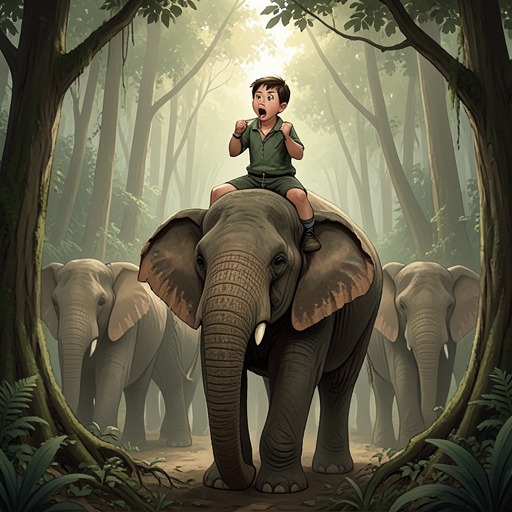
Little Toomai watches this work from the top of a quivering stockade post. His sun-bleached hair hangs loose in the torchlight as he shouts instructions and encouragement to Kala Nag above the uproar. He calls for the old elephant to go on, strike, and take care around the posts, and the experienced elephant catchers notice how intensely he understands the action. The boy is not merely watching a spectacle: he is reading the movement of bodies, ropes, barriers, and trained obedience within the enclosure.
His eagerness also brings him into immediate danger. One night he climbs down from the post and slips among the elephants to lift the loose end of a rope for a driver struggling with a kicking calf. Kala Nag catches him in his trunk and hands him back to Big Toomai, who slaps him and returns him to the post. The episode shows both the boy’s courage and the limits of his judgment: Keddah rewards practical nerve, but it can crush an inexperienced body without warning.
Little Toomai and the Forbidden Boundary
Big Toomai regards Keddah work as an occupation belonging to the jungle hunters rather than to plains drivers and mahouts. He wants brick elephant lines, secure stalls, broad roads, and predictable duties instead of fever-filled forests and wild beasts. He scolds his son for meddling in elephant catching and fears that Petersen Sahib may turn the boy into a full-time hunter who sleeps in the jungle and risks being trampled.
Petersen Sahib, the head of the Keddah operations and the man credited with knowing more about elephants than any living person, sees something different in Little Toomai. He gives the boy four annas for facing a full Keddah at his age and says that he may become a hunter. Yet he also warns that Keddahs are not places for children to play. The permission he offers is deliberately impossible by ordinary human standards: Little Toomai may enter all the Keddahs when he has seen the elephants dance.
Among elephant catchers, this is an old joke meaning never. Hidden clearings known as elephants’ ballrooms are found only by accident, and no human being is said to have witnessed the dance. The joke thus turns Keddah into a social boundary as well as a physical one. Little Toomai has already entered its violence, understood its labor, and proved useful within its machinery, but adult expertise still defines the deepest knowledge of the forest as inaccessible to him.
The Stockade and the Secret Dance
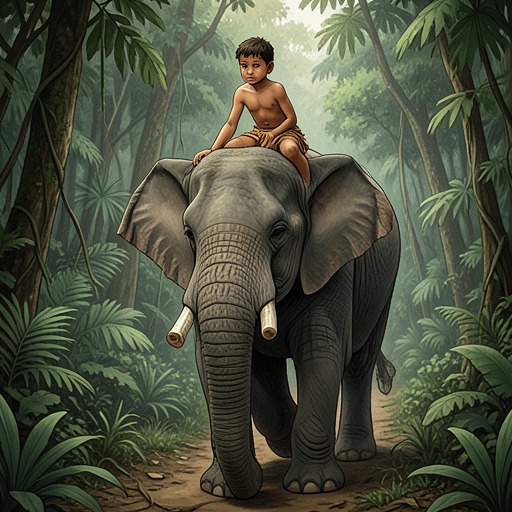
The boundary changes when Kala Nag carries Little Toomai through the night toward a place no human has deliberately found. After crossing the misty river, the elephant follows a path six feet wide, already flattened by many animals. At the summit, Keddah’s human architecture gives way to an elephant-made clearing: an irregular space of three or four acres, its ground stamped as hard as brick, with trees rubbed smooth and not a single blade of green within the circle.
The clearing is a hidden counterpart to the stockade. Keddah gathers elephants through human planning, posts, gates, ropes, noise, and commands; the dance ground gathers them through an order that leaves no human structure behind. Under the moon, wild males, mothers with small calves, young elephants, old females, scarred bulls, and animals marked by tiger claws emerge from the surrounding trees. Though the forest outside is full of crashing branches, the elephants move within the circle like ghosts.
Little Toomai’s arrival fulfills Petersen Sahib’s condition and overturns its meaning. What the catchers treat as a joke becomes a genuine initiation. Keddah had seemed to be the highest arena of elephant knowledge because it displayed the most dangerous human control over animals. The secret clearing reveals a deeper animal society, one that exists beyond the stockade, beyond the Government’s routines, and beyond the categories of catcher, driver, captive, and working elephant.
Narrative Significance
Keddah concentrates the book’s contrast between human institutions and animal capacities. It is a place where bodies are counted, driven, roped, trained, marched, and assigned economic use; the wild elephants are brought into a system that depends on their strength while denying their freedom. At the same time, the stockade makes visible the intelligence and courage of the animals who perform this labor, especially Kala Nag, whose judgment and experience are indispensable to the men.
The location also organizes Little Toomai’s movement from imitation to recognition. At first he wants to belong to the adult world of elephant catchers and earn the status that Petersen Sahib can grant. Within Keddah he demonstrates bravery by shouting from the posts and risking himself to help with a rope. Beyond Keddah he encounters an order that human authority cannot authorize or supervise. The stockade is therefore both a workplace and a limit: it teaches him the techniques of human control, then points him toward the independent life of the elephants that control can never fully contain.